

 Vet Recommended
 Voted #1 by Top Trainers & K9 Units
 Made in USA
 Third-Party Tested
Do Lean Dogs Live Longer? What a Lifelong Labrador Study Found

Same breed. Same food. Nearly two more years.
What if the difference between 11 and 13 years was already in the bowl?
Most conversations about dog weight and lifespan start with an obviously heavy dog.
This one starts with 48 Labrador Retriever puppies.
In a lifelong feeding study, the puppies were paired, and one dog in each pair was fed 25% less food than its pair-mate, from 8 weeks of age until death.¹
No special formula.
No supplement.
Just less food.
October is World Pet Obesity Month, and this is the study we want every dog person to know.
The Gap Was Smaller Than You'd Think
The study began in 1987. The last dog died in 2001, at 14.5 years old, according to the researchers' two-decade summary.²
Between ages 6 and 12, the full-fed dogs averaged 6.7 on a 9-point body condition scale, where 1 is very thin and 9 is very obese. The restricted dogs averaged 4.6.²
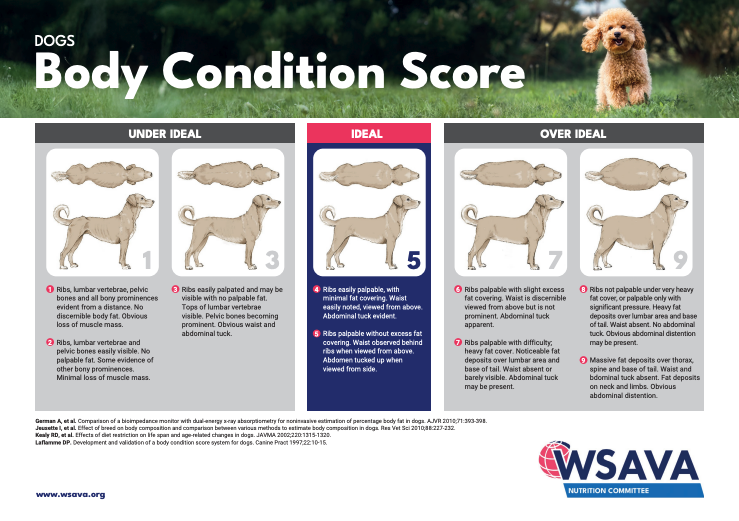
On the WSAVA body condition chart many veterinarians use today, also a 9-point scale, ideal for a dog is 4 to 5.
Meaning: one group lived at ideal. The other lived about two points above it, carrying extra weight most of us would call "just a little solid."
Dog Weight and Lifespan: What Did Two Points Cost?
Median lifespan for the restricted dogs: 13.0 years.
For their full-fed pair-mates: 11.2 years.²
Median means the middle dog in each group: half lived longer, half didn't.
Meaning: the typical lean dog got about 1.8 more years.
The joints tracked the same way. At age 2, hip osteoarthritis (wear-and-tear arthritis) showed on X-rays in 42% of the full-fed dogs and 4% of the restricted dogs. By age 8, arthritis in two or more types of joints showed up in 77% versus 10%.²
Meaning: by their second birthday, nearly half the heavier dogs already had arthritis changes in their hips. Almost none of the lean dogs did.
The restricted dogs also needed long-term treatment for a chronic condition later in life: a median of 12.0 years, versus 9.9.²
Meaning: the lean dogs went about two years longer before needing ongoing care.
For a sport dog or a working K9, those joints are the career.
For a companion dog, they're every walk and every set of stairs.
What Can One Study of 48 Labradors Really Tell You?
Less than a headline would claim.
It was one breed, from seven litters, at one research facility, funded by Nestlé Purina.² The authors note Labradors are prone to obesity.²
Meaning: a pet food company paid for it, and the breed gains weight easily. Neither makes it wrong, but both are worth knowing.
It doesn't promise your Malinois, Border Collie, or senior mixed breed the same 1.8 years.
It started in puppyhood and ran for life, so it doesn't tell us what slimming down a middle-aged dog will add.
What it does show, in real dogs over real lifetimes: leaner tracked with longer, and with later.
Meaning: lean dogs lived longer and got joint and health problems later.
Start with your hands. The WSAVA chart describes an ideal dog as having ribs you can feel without excess fat, a waist behind the ribs when viewed from above, and a tucked abdomen from the side.
Feel for those ribs this week.
Then ask your veterinarian where your dog sits, and adjust together.
Learn the dog in front of you.
Lean isn't less love. It may be more time.
Featured Labrador: lockednloadedlabs
References
- Kealy, R. D., Lawler, D. F., Ballam, J. M., Mantz, S. L., Biery, D. N., Greeley, E. H., Lust, G., Segre, M., Smith, G. K., & Stowe, H. D. (2002). Effects of diet restriction on life span and age-related changes in dogs. Journal of the American Veterinary Medical Association, 220(9), 1315–1320. https://doi.org/10.2460/javma.2002.220.1315
- Lawler DF, Larson BT, Ballam JM, et al. Diet restriction and ageing in the dog: major observations over two decades. Br J Nutr. 2008;99(4):793-805. https://doi.org/10.1017/S0007114507871686
Other sources
- Association for Pet Obesity Prevention. Health Connects Us All: Preparing for the 2026 Global Prevalence Study. No publication date shown; accessed October 12, 2026. Page
- World Small Animal Veterinary Association (WSAVA). Body Condition Score chart (dog). No issue date printed on the chart; file posted under WSAVA's 2025/06 uploads; accessed October 12, 2026. PDF