

 Vet Recommended
  Voted #1 by Top Trainers & K9 Units
  Made in USA
  Third-Party Tested
 National Black Dog Day: Black Dog Myths, Folklore and the Truth About Black Dogs in Shelters

Black Dogs, Bad Luck & the Stories We Still Carry
Why have black dogs spent centuries being associated with fear, bad luck and the unknown? And could some of those old perceptions still influence how we see black dogs today?
For National Black Dog Day, we're going further than celebrating a coat color.
We're going back to the folklore.
Because long before black dogs appeared on shelter websites and adoption feeds, they were appearing in stories.
Where Did the Black Dog Myth Come From?
Across Britain and other parts of Europe, black dogs became recurring characters in folklore.
They were said to appear along dark roads, forests, churchyards, crossroads and coastlines. Depending on where the story was told, seeing one could represent danger, death, protection, warning or even guidance.
One of the most famous was Black Shuck, the legendary black dog of East Anglia in England.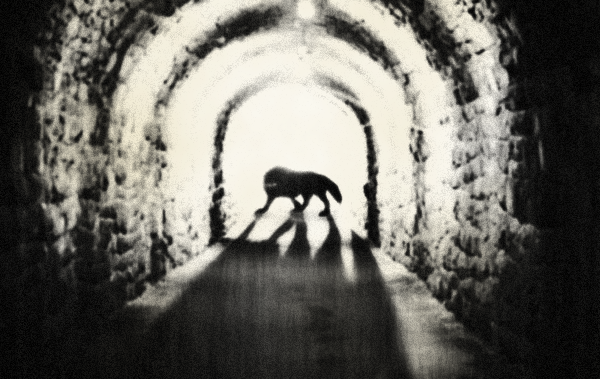
Stories described an enormous dark dog roaming the countryside, sometimes with glowing or fiery eyes. One particularly famous account dates back to 1577, when a mysterious black dog was reportedly seen during a violent storm at churches in Suffolk.
It became the kind of story people remembered.
But here's the interesting part:
The black dog wasn't always the villain.
Some folklore portrayed these dogs as guardians or protectors. Others described them as companions to travelers.
The black dog represented the unknown, and humans filled in the rest.
Then Folklore Became Entertainment
Those stories didn't disappear.
They became books, ghost stories, movies, television and popular culture.
Even today, put a large black dog in a dark scene and most of us immediately understand what the filmmaker is trying to communicate:
Danger.
Mystery.
Power.
Fear.
That's effective storytelling.
But it's terrible canine behavior science.
A black coat doesn't tell us whether a dog is aggressive, friendly, confident, fearful, driven, social or independent.
It tells us the dog has a black coat.
Yet it raises an interesting question.
After centuries of telling these stories, do our perceptions of black dogs still follow us?
The Modern Black Dog Story
That question eventually made its way into the shelter world.
You may have heard the term "Black Dog Syndrome," the idea that black dogs are overlooked or wait longer for adoption.
The reality isn't quite that simple.
One shelter study found that black dogs had the longest median wait for adoption at 32 days, compared with 17 to 27 days among the other coat colors studied.
You can see this study explained by our Chief Science Officer , here.
Get the study: Phenotypic Characteristics Associated with Shelter Dog Adoption in the United States
But larger U.S. research has painted a more complicated picture, finding that coat color by itself wasn't necessarily what determined whether a dog was adopted.
Things like age, size, breed type and even geographic location can matter too.
In other words:
Black Dog Syndrome isn't something we should assume happens everywhere. But that doesn't mean we should ignore places where black dogs really are waiting longer.
What We See Still Matters
There is another piece of this that statistics can't completely capture: first impressions.
Today, someone's first interaction with a shelter dog might happen while scrolling through their phone.
Black dogs can disappear into poor lighting and dark kennel backgrounds. Their eyes and facial expressions can be harder to capture in a bad photograph.
Then add size and breed perception.
A large black working-type dog may be judged not only by coat color, but also by their body, head shape, breed appearance and energy.
That's a lot of assumptions being made before someone ever meets the dog.
And that's where an old conversation suddenly feels very current.
Don't Adopt the Myth. Meet the Dog.
The answer isn't to adopt a black dog simply because they're black.
It's to stop allowing appearance to make the entire decision.
Look at the dog.
Learn their behavior.
Understand their breed and genetics.
Ask about their energy.
Learn what motivates them.
Consider what kind of home, training and biological fulfillment they need.
Because a black dog can be a companion dog, sport dog, police K9, detection dog, hunting dog, service dog, farm dog, adventure partner or professional couch hog.
Coat color doesn't tell you which one is standing in front of you.
National Black Dog Day: Keep the Folklore, Lose the Stereotype
Black dogs have spent centuries playing characters in human stories.
Ghosts.
Guardians.
Omens.
Monsters.
Protectors.
The folklore is fascinating and worth preserving.
The stereotype isn't.
Today we know enough about dogs to understand that temperament, behavior and suitability are far more complicated than the color of their coat.
And the shelter data gives us another reason to keep asking questions rather than making assumptions.
So this National Black Dog Day, celebrate the black dogs.
Share them.
Photograph them.
Learn their history.
Take a second look at the ones waiting in shelters and rescues.
And remember:
Black dog does not equal bad dog.
Keep Black Shuck in the folklore.
Learn the dog standing in front of you.
References
Cain CJ, Woodruff KA, Smith DR. Phenotypic Characteristics Associated with Shelter Dog Adoption in the United States. Animals (Basel). 2020 Oct 24;10(11):1959. doi: 10.3390/ani10111959. PMID: 33114345; PMCID: PMC7690869.