

 Vet Recommended
 Voted #1 by Top Trainers & K9 Units
 Made in USA
 Third-Party Tested
One Plate, One Pancreas?
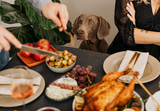
Every November, the warning makes the rounds.
Turkey skin. Gravy. Buttery leftovers.
"One plate of holiday scraps can give your dog pancreatitis."
You'll see it in your feed and hear it at training.
Pancreatitis in dogs is real, painful, and sometimes serious. So the question deserves a straight answer:
Is one rich meal enough to cause it, or is the story bigger than the plate?
Why Holiday Food Gets Blamed for Pancreatitis in Dogs
The rich-food logic. Holiday plates are rich. The thinking goes that the pancreas, the organ that helps digest fat, gets overwhelmed by a sudden load.
The blood-fat logic. The story continues that rich food pushes up fat in the blood, and very high blood fat tips the pancreas into trouble.
The timing. If a dog gets sick after a feast, the feast is the obvious suspect.
What Was Actually Tested
The table-scrap claim: studied in dogs, but only by looking back. A study that looked back at dietary factors and pancreatitis in dogs compared 198 dogs diagnosed with pancreatitis against 187 dogs with kidney failure and no signs of pancreatitis, using medical records and owner phone interviews.¹ Dogs that had gotten into the trash had 13.2 times the odds of pancreatitis. For table scraps in the week before diagnosis, the figure was 2.2.¹
Meaning: raiding the trash was the strongest link. Table scraps were linked too, but far more weakly. And looking back shows a link, not proof that the food caused the disease.
The blood-fat claim: real, but measured in one breed, on a blood test. In a study of 195 Miniature Schnauzers, dogs with severe hypertriglyceridemia (very high blood fat) were 4.5 times more likely than schnauzers with normal levels to have a pancreas blood test result (pancreatic lipase) consistent with pancreatitis.²
Meaning: in this breed, very high blood fat and a test result pointing to pancreatitis tended to show up together. That is one breed and one test, not a diagnosis.
The "one plate" claim: untested. We found no study that fed dogs a single holiday meal and tracked who got sick. A U.S. survey covering 170 dogs with high pancreatic lipase results found an adult maintenance dog food in 65% of the diet histories reported, and human foods in 29%.³ The authors note that fat intake was not measured.³
Meaning: regular dog food showed up in about two of every three diet histories. Human food showed up in fewer than one in three.
What the Hype Misses
Higher odds are not a sure thing.
And in most cases, nobody finds the trigger. The Merck Veterinary Manual's pancreatitis page for dog owners says that for most cases "no specific cause can be identified."⁴
Meaning: in most dogs with pancreatitis, no one can point to a single cause, holiday plate or otherwise.
The dog matters, too. Miniature Schnauzers, Yorkshire Terriers, Cocker Spaniels, Dachshunds, Poodles, and sled dogs show higher rates.⁴
What the Evidence Supports, and What It Doesn't
What holds up: in dogs, trash raids and table scraps are linked with pancreatitis. Very high blood fat is linked in Miniature Schnauzers.
What doesn't: proof that one plate causes it, or that skipping scraps guarantees it won't happen.
So secure the trash. Skip the fatty leftovers. Know the signs. In severe cases, the most common are loss of appetite, vomiting, weakness, belly pain, dehydration, and diarrhea.⁴ If you see them, call your veterinarian promptly.
Share the gratitude.
Guard the garbage.
References
-
Lem KY, Fosgate GT, Norby B, Steiner JM. Associations between dietary factors and pancreatitis in dogs. J Am Vet Med Assoc. 2008;233(9):1425-1431. doi:10.2460/javma.233.9.1425 PubMed record
-
Xenoulis PG, Suchodolski JS, Ruaux CG, Steiner JM. Association between serum triglyceride and canine pancreatic lipase immunoreactivity concentrations in miniature schnauzers. J Am Anim Hosp Assoc. 2010;46(4):229-234. doi:10.5326/0460229 PubMed record
-
Cridge H, Scott N, Steiner JM. Risk factors and clinical presentation in dogs with increased serum pancreatic lipase concentrations—a descriptive analysis. Animals (Basel). 2022;12(12):1581. doi:10.3390/ani12121581 PubMed Central record
-
Steiner JM. Pancreatitis and other disorders of the pancreas in dogs. Merck Veterinary Manual. Updated December 2024. Accessed November 17, 2026. https://www.merckvetmanual.com/dog-owners/digestive-disorders-of-dogs/pancreatitis-and-other-disorders-of-the-pancreas-in-dogs